Showing posts with label CDs. Show all posts

Friday, December 15, 2017

Deluxe Figurine & Music Set

• Deluxe toy & music set •

Deluxe Vinyl Figurine & CD Set

We have small quantities of the much-celebrated and beautifully-designed deluxe vinyl figurine and CD set made by Presspop in Japan for only $65. (+ shipping). They are brand-new. The limited-edition package features a miniature replica of Raymond Scott's patented 1950s keyboard synthesizer, The Clavivox, and a CD featuring rare tracks from the Scott Archives, produced and compiled by Jeff Winner (me).

 • To order Vinyl Figurine & CD set with PayPal CLICK HERE <

Tuesday, July 11, 2017

Jeff Winner: Three Willow Park interview

Layne Weiss recently wrote a fine article for the L.A. Weekly about Raymond Scott's electronic music years. The online version can be read at "Can Synthesizers Compose Music? Nearly 50 Years Ago, This One Could."

Weiss conducted many interviews, and editorial space invariably limits each respondent to a few choice quotes. Last week we posted the full interview with Irwin Chusid, the co-producer of Three Willow Park, the new 3-LP/2-CD collection of vintage, previously unissued Scott electronica. This week we offer the complete interview with Three Willow Park Associate Producer Jeff Winner (who also co-produced Manhattan Research Inc., 3WP's Scott electronica predecessor).


Layne Weiss: When and where did Raymond Scott develop his Electronium?

Jeff Winner: Raymond had been developing Electroniums out of the public eye throughout the 1950s. He moved to L.A. in 1971. He was nearing his mid-60s, had lived his life in New York, and was willing to make a major transition at that stage. He had his third wife, Mitzi, and this was like a whole new start. It ended up being his final professional gig because his health declined during the period.

LW: How long did he work before his health started declining?

JW: He started having heart trouble much earlier—in the 1950s. Later he had a stroke and heart attacks. The span of his Motown tenure was about 7 or 8 years from the time he started working for them under contract on Long Island, through moving west and getting a full-time position with Motown. They retired him around 1977 because of his health.

LW: When did he start working for Motown and how did he transition to L.A.?

JW: In 1969 he started to publicize the Electronium. In 1970, Motown owner Berry Gordy and his entourage arrived at Scott's Three Willow Park facility in Farmingdale, Long Island, to see a demonstration of what was, at the time, Scott's state-of-the-art Electronium.  Gordy was so impressed that he said, “Here’s a check for $10,000 to get started and build one for me.”  That one that you see in the color photograph with the beautiful wooden cabinet—that’s the one Raymond made specifically for Motown.

When Gordy ordered the Motown Electronium, he stipulated that it was his exclusive thing. Raymond was not allowed to publicize the deal. He couldn’t even put out a press release declaring that he was employed by Motown. Gordy did not want word to leak out that hits were being generated by robots. Raymond was disappointed about that.

LW: When did all this info start coming out?

JW: It was known prior to Scott's death but hadn’t been explored in detail. We’ve made attempts over the years to reach Gordy for comment, but we’ve received only polite declines. Hopefully someday that will change. We would love to know how he looks back on it now.

LW: How did the other Motown artists react or warm up to Scott being there?

JW: Some of the studio musicians — when they attempted to play along with the machine, they didn’t like it. They resented being told to play to a click-track. Musicians rely upon their own internal metronomes, their own sense of rhythm—and these guys were amazing instrumentalists. For them to be asked to subordinate their talent to a machine, to let the machine be a leader, some resented that. On the other hand, Michael Jackson was fascinated by the Electronium and wanted to use it. He thought it was the future. And he was right.

Others? We don’t know. We don’t have any evidence. But we know they were all working at the same facility and we presume that everybody was at least given the opportunity to utilize the technologies that they were bringing in. This all goes to a broader wave of technology. Motown had the best recording equipment. As a new decade was dawning, there was buzz about this new thing called a "synthesizer." In 1970 Bob Moog introduced the Minimoog to the consumer market. Now you had a mobile synth. It could go from city to city on tour for the first time. That was the year when the revolution really coalesced in terms of technology, availability, price and mobility. It’s probably not a coincidence that Gordy was so turned-on by the Electronium at the same time.

LW: Do you have any examples of artists that weren’t thrilled by working with Scott or his Electronium.

JW: Hoby Cook, an engineer, was assigned to record session musicians playing along with the Electronium. He provided an interesting chronicle of the musicians rebelling against the experiment. We don’t know of any high-profile names who were not into it. People have speculated that Stevie Wonder would be a logical candidate to use it because he loves synthesizers. I don’t think he was a great prospect. For one thing, he’s blind and probably couldn't operate it. Second, the main purpose of the Electronium was to come up with its own bass-line, grooves, melodies, and rhythms. The last thing Stevie Wonder needed was help generating musical ideas.

ABOVE: Berry Gordy in Motown studio, 1960s.
LW: Scott was not very sociable and he created a lot of his devices so he wouldn’t have to deal with people. What was it like for him having to meet people and demonstrate how this stuff worked?

JW: He was fine with that — as long as there was something technical as a conduit. He was probably in his element at Motown. He respected them, and they respected him. They were fascinated by the technology and he was the grand wizard who was trying to give them the keys to the future. He taught studio staff at Motown how to help musicians use the device, so he wouldn't have to keep doing it. He was happier in that later stage of life because he was doing what he really wanted to do. He explained that in a letter to a fan in 1980. He said it was the most enjoyable time of his life, working with electronic instruments and electronic music.

LW: Do you know how his family felt about relocating?

JW: Mitzi, his third wife, loved him tremendously and she would have done anything he wanted. It was a lot of work for her because he was so busy — it fell on her to return to Three Willow Park to close down the facility. He had tons of equipment, and tape reels, and she had to sell some of it. Some stuff got thrown away and the rest of it she had transported to L.A. They rented a furnished apartment while Gordy and Raymond worked at Gordy’s house. He had an amazing estate in Bel-Air. They set up a laboratory above the garage, and then it all got moved to the Motown facility. Mitzi and Raymond eventually settled in Van Nuys. After Raymond passed in 1994, Mitzi moved to Santa Clarita. Raymond stayed in California for the rest of his life. He loved the weather and taking long drives through the mountains and near the coast.

LW: Was he star-struck at all?

JW: Not at all. He'd been a celebrity since he was young. He wrote his first hit tune at age 25. His older brother was a CBS radio star before he was. He rubbed elbows with everybody from Sinatra and Crosby to Smoky Robinson, Michael Jackson and Diana Ross. He collaborated with Jim Henson. He was part of the 20th century entertainment industry. There were artists he admired, but the idea of him, say, asking for an autograph seems unfathomable. He was a celebrity himself, but he didn’t go out and party with other stars. He was a recluse who focused on work.

LW: Were Raymond and Gordy friends or was it just professional?

JW: They got along great. Raymond was at his house from 9 to 5 every day. They were close the first couple of years. Gordy was aware of Scott's early career as a hit-maker, starting in the 1930s. Gordy was aware that he was getting not just a technological wizard, but a guy who knew how to compose hit tunes. And of course Scott was aware of Gordy’s amazing accomplishments. In the 1960s Motown was unstoppable. They dominated the pop charts. Even in the ‘70s they continued to be potent with the Jackson 5, Diana Ross, Stevie Wonder, Earth, Wind & Fire, and Marvin Gaye.

ABOVE: 2-CD and 3-LP versions of 'Three Willow Park'
LW: How about some info on the new album, 'Three Willow Park'?

JW: This is the first time the public will be hearing the Motown Electronium. The span of the recordings is from 1961 to 1971, so there’s material that pre-dates the Motown Electronium, when Raymond was still living in Manhasset, New York, in a giant 32-room mansion, with then-wife Dorothy Collins. There’s material from #3 Willow Park after he moved there in 1965. And there's some material from the early part of his Motown tenure in L.A. through 1971. So the 1970-’71 recordings feature the Motown Electronium. All prior recordings with the Electronium feature earlier versions of the device. It’s a progression in terms of chronology — from the material on Manhattan Research Inc. to Three Willow Park.

The non-working Motown Electronium was purchased in 1996, a couple of years after Scott passed away, by Mark Mothersbaugh of Devo. He’s also a successful film composer. He's done Wes Anderson movies and Disney projects, such as The Lego Movie. Mark kept the Electronium in his L.A. studio for a long time. It was moved to Portland for restoration. It’s now coming back to L.A. because a new restoration attempt is being undertaken by Brian Kehew. Among many other roles, he’s a keyboard tech for The Who. He’s working with Wally de Backer (a.k.a. Gotye), who’s providing financial assistance.

Monday, July 03, 2017

Irwin Chusid: Three Willow Park interview

Layne Weiss recently wrote a fine article for the L.A. Weekly about Raymond Scott's electronic music years. The print version, genuflecting to Thomas Edison, bears the clever title "The Wizard of Willow Park." The original online title, "In the '70s, Motown Hired a Synth Wizard to Build Them a Songwriting Machine," was later changed to "Can Synthesizers Compose Music? Nearly 50 Years Ago, This One Could."

Weiss interviewed me two months before the release of Three Willow Park, the new 3-LP/2-CD collection of vintage, previously unissued Scott electronica, which I co-produced with Gert-Jan Blom (with Jeff Winner as Associate Producer). Weiss conducted many interviews, and editorial space invariably limits each respondent to a few choice quotes. Below are the full replies I sent to Weiss, provided here for additional background on the development of Three Willow Park.

Layne Weiss: Why is now the time to release this project? 

Irwin Chusid: Because we finally finished it. The followup to Manhattan Research Inc. (released in 2000) was long overdue, but for a number of reasons, was repeatedly postponed. The additional time made it a better project because we were able to collect more material and construct a more detailed chronicle about Scott’s years at Three Willow Park Center. 

LW: What should listeners expect as far as sounds, music, and content, and why is this release special for Raymond's family, you, Gert-Jan, Jeff, and for music fans in general?

IC: It’s different than MRI. For one thing, it features the sounds made on Scott's Motown-era Electronium, which was the "Mark 2," refined version. There was no "Mo-tronium" on MRI. An earlier, less-refined incarnation was featured. That album also included dozens of early TV and radio commercials with electronic music and effects soundtracks. There are no commercials on 3WP, although there are a handful of sound effects from ads. 3WP features a wide array of music and sounds. Some are accessible and pleasant. Others will peel layers off your cerebral cortex. We tried to program the tracks for constant surprises. Everything we used we consider listenable. There's something for everyone, but we can’t guarantee that everyone will enjoy it all. The moods range from relaxing to brutal. 

LW: Can you explain the significance of the title? Maybe give some insight on Raymond's life at Three Willow Park or just explain what it was and why it's so important. 

IC: Number 3 Willow Park Center was a large rental bunker in an industrial development in Farmingdale, New York. Built in the early 1960s, Willow Park Center was a patch of suburban real estate where corporations based headquarters, small companies leased office space, and manufacturers kept warehouses. Sometime after the summer 1964 demise of his marriage to singer Dorothy Collins, Scott moved to Willow Park to set up his electronic music lab. When I say "moved," I mean "moved in." He lived there. Residential occupancy wasn't legal under local zoning regulations, but Scott paid his rent and outfoxed the lease police. It was at Three Willow Park that he built the Electronium. He was living there when he met and married his third wife, Mitzi—who besides cooking his meals, kept his books and learned how to solder circuitry. She’s an important part of the story, and there’s a photo of her on the back of the LP set. This makeshift compound remained Scott's atelier and bedroom until around 1971, after which Raymond and Mitzi decamped for Los Angeles, where he went to work for Berry Gordy at MoWest.

LW: Why did you choose these particular ten years of music (1961-1971) to have on the album?

IC: It's a nice, tidy decade. The earliest tracks we considered date from 1961. Anything earlier was on MRI, whose oldest track dates from 1953. The recordings on 3WP end at 1971, because in 1972 Scott went to work for Motown. Gordy hired him to develop the Electronium—which composed by itself using programmed intelligence—as an "idea generator." In particular, the Electronium was great at improvising complex melodies and rhythms. While Scott was employed there he was under a strict gag order. Motown contractually prohibited him from publicizing the nature of his employment. They were worried that their fans might think that Motown’s instrumental stylings were being performed by “Mo-bots.” As far as we know, the Electronium was never used on any Motown recordings, but we know that a young Michael Jackson would occasionally drop in Scott’s on-site studio to watch the device work. We don't have a direct quote, but someone who worked there with Scott said Jackson was quite excited by the machine's possibilities. 

LW: Has this music been previously unheard by the public? How do you feel about releasing it?

IC: 98% of the music on 3WP has never been publicly circulated, altho a few pieces have been played on the radio or previewed for inquiring journalists.  

LW: Where will people be able to buy it?

IC: Anywhere fine music is sold. We have expressly forbid it to be sold where bad music is purveyed.  3WP will be available as a 3-LP set, 2-CD package, and digital. We will also offer a free 349-page downloadable pdf consisting of documents, photos, and ephemera chronicling Scott’s career in electronic music and engineering.

Friday, May 12, 2017

The Portofino Variations


Raymond Scott's 1962 tune "Portofino" has become a belated "hit." It's been licensed for the TV show Narcos, the film Best of Enemies, used in a Gucci commercial, and garnered more single-track downloads than any track on Manhattan Research Inc., the Y2K anthology of vintage Scott electronica on which it was first released. Basta has commissioned 20 contemporary versions of the composition and collected them on a new album, The Portofino Variations. The album, officially released today, features "Portofino" recorded by Fay Lovsky, Arling & Cameron, the Metropole Orchestra, Ocobar, Davide Rossi (Goldfrapp, Coldplay, The Verve), Jacco Gardner, Eva Auad, and others. The tune is interpreted in a wide array of styles: surf guitar, whistling, electronica, chamber ensemble, minimalism, pop, rock guitar, and scat vocals. The compilation even contains two song versions with original lyrics. The album is available on CD and digitally on Basta, and on LP by Music on Vinyl (a limited edition of 1,000 numbered LPs on gold vinyl, featuring two previously unreleased 1962 takes by Scott). The cover art features an adaption of a painting by Jim Flora entitled Portofino—which by coincidence was rendered in 1962.

Listen here on Spotify.

Friday, March 06, 2015

Raymond Scott Songbook (the Video)

Our friend and fellow Scott scholar Takashi Okada, of Tokyo, has produced a 3-1/2-minute video showcasing THE RAYMOND SCOTT SONGBOOK, which he produced in cooperation with the Scott estate.


This is part 1 of a 2-part series; part 2 next week.

Tuesday, February 18, 2014

REWIRED released


Street date: TODAY. As in, NOW. CD and digital.

Rhythmic redesigns by three extraordinarily talented sonic artists.

Contains real Raymond Scott music, as well as some original sounds. Over 250 RS samples went into the album's 19 tracks.

All the info at ScottRewired.com.

And contrary to some online listings, there is NO vinyl edition. Yet.

Monday, February 03, 2014

Raymond Scott Rewired


UPDATE (Feb 6): Raymond Scott Rewired now has a website.

As a musician, composer, bandleader, and inventor, Raymond Scott was a perfectionist, but not a stylistic purist. His late-1930s six-man "Quintette" crafted novelty jazz that layered ethnic contours and pan-global riffs over a propulsive beat. In the 1940s Scott's antic melodies were adapted in Warner Bros. cartoons because WB music director Carl Stalling found the compositions genetically animated. Scott's mid-century orchestral works were danceable, except when they veered into complex, cerebral concert-jazz. In the 1950s and '60s Scott invented and recorded with electronic instruments. He was a genre-hopper, reflecting a musical restlessness and adventurousness. Scott loved what he did, but craved what came next.

As archivist for the Scott musical estate, I commissioned three remix artists to take apart Scott's catalog and reshape it in a fresh way. The Bran Flakes (Otis Fodder, Montreal), The Evolution Control Committee (TradeMark Gunderson, U.S.), and Go Home Productions (Mark Vidler, U.K.) were ftp'ed hundreds of Scott recordings in various genres, including unreleased material, spanning the 1930s to the 1980s. They were invited to have fun, but keep it rhythmic. Each contributed six audio montages with new titles, and they collaborated on Scott's signature tune, "Powerhouse."

The result is RAYMOND SCOTT REWIRED, produced for the Basta label. The album will be released in North America on February 18. Three tracks can be streamed on Soundcloud.

Over 250 sample sources were used in the construction of these 19 tracks. Those samples were edited, looped, flipped, and stretched; they were tweaked with EQ, pitch-shifted, compressed, and transformed. Disassembling one man's sonic legacy and reassembling the pieces into something different, something worth hearing repeatedly, requires an intuitive gift that approaches songwriting. Scott fans will recognize some passages, but in countless cases, the source recordings have been altered beyond recognition. The composer himself would have difficulty identifying his own works. The reconfigurations were done playfully, but respectfully. Nothing was destroyed. The originals still exist.

The cover art was adapted from an unfinished, untitled, black & white Jim Flora illustration from the 1950s.

Wednesday, January 29, 2014

A mixed-up, mashed-up composer

Coming from the Basta label in February 2014.


We turned over the entire Raymond Scott catalog ...


... to three celebrated mixologists who work under group names: The Bran Flakes, The Evolution Control Committee, and Go Home Productions.


They were given hundreds of recordings owned by the Scott estate, in all genres, including unreleased material, spanning the mid-1930s to the mid-1980s. Jazz, orchestral, electronic, experimental, studio chatter, one-of-a-kind rarities.


These gents were invited to have fun, keep it rhythmic, and make it percolate. Each contributed six audio montages with new titles, and they collaborated on Scott's signature tune, "Powerhouse."


The project is titled RAYMOND SCOTT REWIRED.


It's finished. Mixed, mastered, designed, packaged, and manufactured. You can preview three tracks on Soundcloud. Official release date is February 18.

Note: This post was originally published in May 2013. However, the US release was postponed due to a change of distributor for this release. 

Tuesday, February 05, 2013

New Deluxe 2-CD Box Set from Japan

The new 2-CD set titled "SONGBOOK" from Daisyworld in Japan includes previously unreleased vintage recordings, with a second disc of new covers by Benoît Charest featuring Kid Koala, Optiganally Yours, Jean-Jacques Perrey & Dana Countryman, Ego Plum, Mint-Lee & many more. The deluxe box-set package designed & produced by Takashi Okada comes with a 100-page book packed with photos & info, replica reprints of classic sheet music, posters, and ephemera, and is housed in a retro-inspired 7-inch tape-reel box. ORDER here, and please note: prices include shipping from Japan for this unique collectors item.
Click image above for larger view

Monday, June 27, 2011

Watch The Closing Doors:
A History of New York’s Musical Melting Pot

Watch The Closing Doors: A History of New York’s Musical Melting Pot is a new double CD and LP series, released today, and compiled by renowned journalist and author Kris Needs:
Needs’ frighteningly-ambitious project aims to capture the fast-vanishing magic of New York City, documenting major musical landmarks and developments. The first volume focuses on the 1940s and 50s, and is accompanied by a book containing the relevant musical and social history, artist biographies, illustrations and Needs own stories and recollections of the city that once never slept. It includes jazz giants such as Duke Ellington, Louis Armstrong, Dizzy Gillespie, Charles Mingus, Miles Davis, and Thelonius Monk, while John Cage and Raymond Scott represent the avant garde. Among the other artists are Billie Holiday, Allen Ginsberg, Nina Simone, and Cab Calloway.
MOJO magazine: “An intoxicating aurel evocation of a lost world” 4-STARS

RECORD COLLECTOR: “One of the most fascinating compilations series we’ve ever encountered” 5-STARS

THE WIRE: “Essential”

VILLAGE VOICE: “A dream soundtrack of every book you ever read, or wanted to read, about postwar New York City” 

Thursday, January 27, 2011

"Music For A Retro Future"

New various-artists CD, Music For A Retro Future, from the Other Sounds label features important pioneers of electronic music, including Jean-Jacques Perrey, Louis & Bebe Barron, Dissevelt & Baltan, and others: "A companion album to the book Journey To A Plugged In State Of Mind, an introduction to 100 years of Electronic Music. This release traces the early experiments of the synthesizer in movies and into commercial music. Featuring the sounds of room-sized computers, early rhythm generators, and cognitive ideas of many men in white coats. Includes the earliest recordings of Zappa favorite Varèse, the exceptional 'Song Of The Second Moon,' and Raymond Scott's early experiments into synthetic sound." Order from Amazon.com: here

Monday, December 13, 2010

"Christmas Night" with Louis Armstrong

Christmas figured prominently in the early career of Raymond Scott (the son of immigrant Jews). He wrote his first hit, "Christmas Night In Harlem," in 1934 at age 25. During Xmas 1936, he debuted his soon-to-be world-famous band live on the Saturday Night Swing Club radio show. Two Christmases later, Paul Whiteman featured the Quintette, accompanied by PW's huge orchestra, performing Scott compositions at Carnegie Hall as part of the long-running Experiments In Modern American Music series where Whiteman had debuted Gershwin's Rhapsody In Blue in 1924.

"Christmas Night In Harlem" was recorded as an instrumental in 1939 by Scott's Quintette. With lyrics by legendary Tin Pan Alley wordsmith Mitchell Parish, who co-wrote "Stardust," "Deep Purple," and another Yuletide standard, "Sleigh Ride," the tune was covered by Perry Como, Benny Carter, Johnny Mercer, Banu Gibson, The Beau Hunks, Clarence Williams, Paul Whiteman, Maria Muldaur, and Jack Teagarden. A new CD, 100 CHRISTMAS, presents Lester Lanin's version alongside classics by Bing Crosby, Willie Nelson, and Roy Orbison.
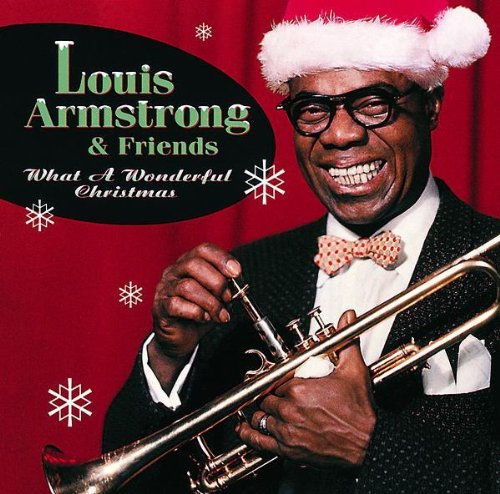
The most celebrated of all "Harlem" covers, however, is by Louis Armstrong, framed above alongside Scott during a 1938 CBS radio broadcast. Satchmo's recording is perennially reissued on holiday collections, including WHAT A WONDERFUL CHRISTMAS.

Download The Metropole Orchestra's version of "Christmas Night In Harlem" from the CHESTERFIELD ARRANGEMENTS album here, as our holiday gift to you. And explore more of the many incarnations of Raymond Scott's earliest hit at Amazon.com or the iTunes Store.

Monday, November 01, 2010

DE NUEVO EN EL INFIERNO

Madrid-based sextet Racalmuto have released a fantastic new CD titled DE NUEVO EN EL INFIERNO, featuring faithful renditions of seven classic Raymond Scott compositions from the 1930s-'40s:

• "Oil Gusher"
• "The Girl With The Light Blue Hair"
• "Birdlife In The Bronx"
• "Reckless Night on Board an Ocean Liner"
• "A Little Bit of Rigoletto"
• "Suicide Cliff"
• "Tobacco Auctioneer"

An eighth tune associated with (but not composed by) Scott, "Brass Buttons and Epaulets" (from the 1938 film Just Around the Corner), is also included, played in the RSQ arrangement. Other CD tracks include modern takes on vintage tunes by Ellington, Tchaikovsky, and Slim Gaillard, along with one original penned by group leader Miguel Malla.
CD artwork
CD cover artwork

Tuesday, October 05, 2010

The Quintette 7

The West Point Band has been developing a classic Raymond Scott Quintette repertoire for several years, with occasional live performances. They aren't just learning music from Scott—they're studying math. Raymond called his six-man group a "Quintette." The WPB's ensemble is the "Quintette 7." (FWIW, Scott's "Secret 7" band counted as many as a dozen players.)
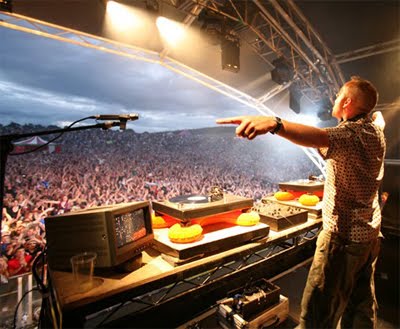
The Q7 just released a CD, Quintette 7 Plays the Music of Raymond Scott. A Sunday afternoon CD launch recital takes place on October 24 at the Academy on the Hudson. It's open to the public, and a reception follows the performance. I've seen the band in concert, and they're terrific. They deliver over a dozen RSQ nuggets in a finely honed chamber-jazz fashion.

Monday, September 13, 2010

Funk Soul Brother

Fatboy Slim is the stage name of Norman Cook, one of the most enduring and successful Pop/Big Beat musicians of the past 20 years. His numerous hits, and collaborations with artists such as David Byrne and Beastie Boys, have earned him the reputation as "the father of mainstream electronic music." Slim has just released five new tracks that he crafted using sample-loops from Raymond Scott's electronic soundtrack for the 1967 film, "The Paperwork Explosion" (directed by Muppet master Jim Henson). The two new EPs, which are collaborations with UK-based DJ/producer Hervé, are titled "Machines Can Do The Work," and "Machines Can Do The Work: Remixed." 

• Both the original, and the "Action Man aka Hervé Acid Mix" versions are available now from the iTunes music store, and Amazon.com

• Also out now, a 20-minute EP with three remixes: iTunes music store/Amazon.com

• Watch the official video: here

Thursday, October 29, 2009

jungle drums, slapped bass & squeaky toys

Stu Brown's Raymond Scott Project CD draws celebratory ink from the UK's Mojo magazine. It's also "Disc of the Day" (Nov 2) at The Jazz Breakfast.

Monday, June 15, 2009

Twisted Toons

We've been covering the development of Stu Brown's Raymond Scott Project for over a year. The CD is now OUT. Stu has posted some tunes from the album on his website in the Audio section. He'll soon be updating his Æ’@ceb()()k and m¥$pÃ¥¢e pages. The album can be pre-ordered directly via Stu's site in the Store section, or via the my§p@¢e page.

The striking cover was designed by Ali Whitty, developed from an original idea by Stu, who says: "The old photo album look continues throughout the inside of the sleeve and on the back cover." Stu adds that later this month the album will be available in the US via digital etailers, CD Baby, Amazon and as a special order via record stores.


TRACK LISTING: 1. Square Dance For Eight Egyptian Mummies 2. Devil Drums 3. The Penguin 4. New Year's Eve In A Haunted House 5. The Toy Trumpet 6. Boy Scout In Switzerland 7. Suicide Cliff 8. In an 18th Century Drawing Room 9. Moment Musical 10. Powerhouse 11. Egyptian Barn Dance 12. Hypnotist In Hawaii 13. Dinner Music For Pack of Hungry Cannibals 14. At an Arabian House Party 15. Tobacco Auctioneer 16. Twilight In Turkey 17. War Dance For Wooden Indians 18. The Bass-Line Generator 19. Toy Typewriter

Friday, June 12, 2009

Lullatone Will Rock You ... To Sleep

THE NEW YORK TIMES reports:
Lullatone are a husband-and-wife team based in Nagoya, Japan, who revere the electronic music pioneer Raymond Scott the way House reveres Facetti. Taking Scott’s 1963 Soothing Sounds for Baby albums as their starting point, Lullatone have developed a hypnotic, childlike sound that attains a lapidary brevity in their sound stamps (basically audio logos) for the Japanese public broadcaster NHK.
Lullatone's newest collection, We Will Rock You… to Sleep (an introduction to Lullatone), is a sampler CD with tracks from all of their previous albums, including one track from their upcoming disc of loops for babies.

Tuesday, May 19, 2009

Vagabond Opera


This Portland OR-based sextet's press kit describes them as "European Cabaret! Vintage Americana! Balkan Belly Dance! Neo-Classical Opera! Old World Yiddish Theater!" (Exclamation points theirs.) VO's new album, The Zeitgeist Beckons, features a calamitous rendition of Scott's spooky "New Year's Eve in a Haunted House."

Thursday, March 05, 2009

Mini Mountain Queen


The Bran Flakes are a couple of sample-happy plunderphonic pirates who throw forgotten '50s kiddie vinyl, Bachelor Pad bridges, mariachi LPs, and homemade electrobeats into the audio blender and hit "puree." Their slice'n'dice sonics come out sounding like a Saturday morning TV soundtrack for today's juvenile genius-nerds destined to shape the technology of 2029.

TBF's new CD, I Have Hands (Illegal Art), is laced with RIAA-baiting sonic re-appropriation. However, it contains at least two works they were granted permission to re-invent: Raymond Scott's electronic "In the Hall of the Mountain Queen" and "Melon Ball Bounce" (from Manhattan Research Inc.), out of which the Flakes fashioned a track entitled "Mini Mountain Queen." Give a listen.