Back in March we featured Part 1 of our friend Takashi Okada's video showcasing THE RAYMOND SCOTT SONGBOOK, a 2-cd set which he produced in cooperation with the Scott estate. We promised Part 2 the following week. We subsequently misplaced our calendar, which only now turned up buried under a dog-eared stack of Scientific American magazines from the 1960s. (We have to get this office organized!)
We now offer Part 2 of Takashi's video, which you'll find was worth waiting for.
Includes cameo appearances by Jean-Jacques Perrey, the Mechanical Orchestra of França Xica, Hirofumi Tokutake, Dorothy Collins, Ego Plum, Beth Sorrentino, Optiganally Yours, Benoît Charest, Haruomi Hosono, and others. (Pictured above: the band Noahlewis' Mahlon Taits; below: vocalist Miharu Koshi)
Saturday, September 12, 2015
Thursday, April 02, 2015
YALE University Documentary Film Screening
![]() |
| Yale Film Study Center |
Monday, March 09, 2015
Growing up with Raymond Scott
Raymond Scott fan Christine Lorraine writes:
I wanted to take a moment to express something — in the mid-1990s you gave me a Raymond Scott CD (Reckless Nights and Turkish Twilights) when my son and daughter were babies. Now they are grown up. Nicole plays sax, and Nicholas plays French horn, drums, cello, and anything else he touches. Nicholas (who also plays drums with my band) recently hopped in the car when I picked him up from work, opened the console, and immediately inserted the Raymond Scott CD into the player. He listened to his favorites since childhood: "Manhattan Minuet," "Tobacco Auctioneer," and "At an Arabian House Party." He can point out where the clarinet squeaks in "Powerhouse" and how the trombones are intentionally dissonant in "House Party." My daughter Nicole does the same thing with the same CD, and she said it has struck her since early childhood that music could ever sound like that.
This is a roundabout way of saying thanks for playing such an indirect yet profound influence on their musical development. Raymond Scott's music is such a treasured part of our lives.
Nicholas (above) had been listening to Raymond Scott since age 3 and
wanted to play drums. Being a musician mom, well, it was no holds barred.
Ages 8 and 10 (above) they performed together playing "Jingle Bells" in the school talent show. She doesn't play sax so much now, but fronts an all-original punk group and writes their lyrics. I wish there were a way to expose more young children to intricate music like Raymond Scott's. I did so experimentally, but what an amazing outcome.
Friday, March 06, 2015
Raymond Scott Songbook (the Video)
Our friend and fellow Scott scholar Takashi Okada, of Tokyo, has produced a 3-1/2-minute video showcasing THE RAYMOND SCOTT SONGBOOK, which he produced in cooperation with the Scott estate.
This is part 1 of a 2-part series; part 2 next week.
Monday, February 23, 2015
Raymond Scott Goes to Middle School
Guest blogger, Deb Scott Studebaker, who is the older daughter of
Raymond Scott and his 2nd wife Dorothy Collins, writes the following:
| Tess, Zack H. and fellow poets perform "The White Clothesline" at The Willows Community School. Photo: Tessa Posnansky |
Take 100 middle school students and a lesson on poetry and art that embraces light and shadow. Add careful observation, thoughtful discussion, and provide an environment where these students can sketch, paint, write and share.
What do you get? A poem called “The White Clothesline,” performed before an audience, with intro music from Raymond Scott Rewired. This mix of words, images and music holds a special meaning for me because Raymond Scott was my father.
Much has been written about Raymond Scott as an unswerving taskmaster, working his musicians relentlessly in pursuit of a lofty standard of perfection. His method of teaching me to play the piano as a young child—practicing endless scales—was anything but fun.
![]() |
| Aidan in "The White Clothesline." Photo: Heidi Roberts |
But my father also had a playful side, as well as a passion for combining and recombining sounds, styles, and genres. That was fun! It was fun for him, and for those who shared his vision. I must have inherited his fascination with combining art forms and modalities.
I’m the third of Raymond Scott’s four children; I am also a writer who teaches poetry at the Willows Community School in Los Angeles. On February 12, ten of my talented students performed a piece that embodied creative confluence—a process dear to my father’s heart.
Confluence: a place where people or things come together. Confluence came to work with me over the past few weeks: Blending art with poetry. Connecting fragments written by 100 students into an ancient poetic form known as the “cento.” Weaving 6th and 7th graders’ voices and perspectives. Bringing ten of those students onstage to speak the truths hidden within a white towel, a pair of white ski pants, and a tiny white sweater. Finally, adding a musical introduction that was a mash-up in itself!
![]() |
| Schaedyn and Malaika perform. Photo: Tessa Posnansky |
When I searched my music library for an intro cue, I wasn’t looking specifically for a Raymond Scott composition. In fact, I brought in three selections to play for my kids. But when I put on “Good Duquesne Air” (audio below)—one of my favorite tunes from the fascinating Raymond Scott Rewired project—we had an immediate groove going on. “That’s so cool!” “What is that?” “Who is that?” I explained that it was my father’s music, reimagined by mixmaster Mark Vidler (of Go Home Productions). On Poetry Night, the vintage and modern elements of “Good Duquesne Air” gave the audience a mysterious feel for what was yet to come.
In a confluence, streams flow and merge together from various sources. Fusing art with poetry opened up wider vistas for our students. Distilling the writings of many young poets into a cento told a new story.
And incorporating even a taste of my father's musical legacy into “The White Clothesline” reminded me that a creative confluence is a gift big enough to share.
Labels:
contemporary nods,
education,
Mark Mothersbaugh,
Rewired,
schools,
theater
Friday, February 20, 2015
February 20, 1937
Raymond Scott music travels at various velocities. It can be delivered on LPs that spin at 33-1/3 revolutions per minute. There are a handful of rare 45 rpm singles. His electronic music was captured on tape that rolled at 3-3/4, 7-1/2, or 15 inches per second. The rotational speed of a Basta compact disc of Scott's Soothing Sounds for Baby varies from 210 rpm (outer edge) to 480 (inner edge). But Scott's music first came to prominence on fragile platters that whirled at 78 rpm.
It is therefore fitting that 78 years ago today, Raymond
Scott entered a New York studio with his legendary Quintette to record his
first commercial sides. It was a productive day. While no one knows how long
the February 20, 1937 session lasted, by the time Scott and his cohorts mopped their brows and went home, they had recorded two timeless classics — "Minuet in Jazz"
and "Twilight in Turkey" — and two immortal works — "The Toy
Trumpet" and "Powerhouse." Not only were these four recordings
all approved for commercial release, they are inarguably the definitive
versions of all four works.
How long did it take Brian Wilson to complete Smile?
Is it done yet?
Al Brackman, an associate producer for the Master label,
which signed the RSQ, told historian Michèle Wood: "Our studio at 1776
Broadway was basically just an office with a seven- or eight-foot ceiling.
There was a long hall leading to it from the elevators. Opposite the office
door, there was a men's room lined with tiles. Scott insisted on recording at
night so he could put one mike in the hall and another in the men's room. With
that and the other mikes in the office he achieved what they call 'echo' and
gave the recordings a big auditorium sound."
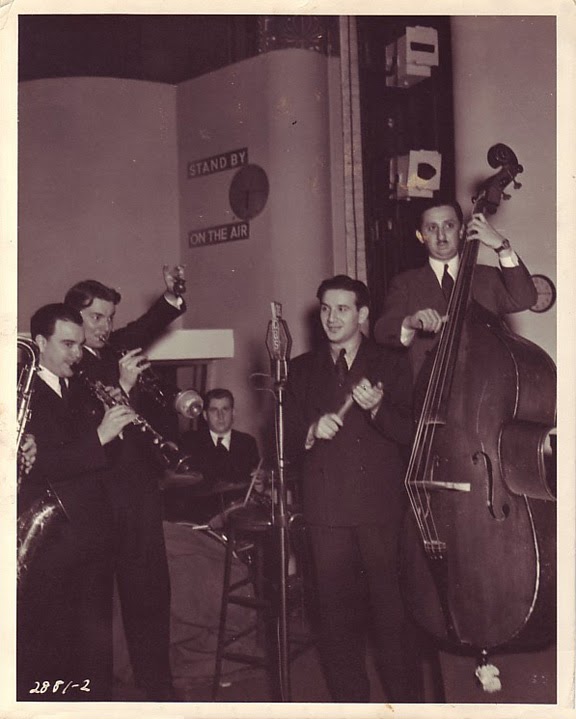
We don't have any photos of that makeshift Broadway chamber, but we have lots of photos of the RSQ during radio gigs (see above—saxophonist Dave Harris was cropped out by the cameraman).
The first RSQ release was "Twilight in Turkey," backed
by "Minuet in Jazz." The disc sold out within a week. "It had
nothing to compete with it," said Brackman. "If you liked Scott, you
had to buy Scott."
Fans first bought "Powerhouse" on the Master label, which went bankrupt in late 1937. The track was reissued on Brunswick in 1938, and in 1939 on Columbia. Same recording each time.
Sunday, February 15, 2015
Ghost Train Orchestra, Feb 28, Brooklyn
Our friend Brian Carpenter, leader of the fabulous Ghost Train Orchestra, whose Book of Rhapsodies CD contains several cleverly arranged works by Raymond Scott, writes:
Don't miss our last show with the Book of Rhapsodies band on Saturday February 28 before we head into the studio to record Book of Rhapsodies Volume II (all of which can be heard live at this show). We'll debut new arrangements of strange and beautiful chamber works penned by Raymond Scott, Alec Wilder, Charlie Shavers, and Reginald Foresythe, as well as a special treat — some pieces by a seemingly unknown bandleader/composer from the '30s and '40s recently discovered by Irwin Chusid. We can't wait to debut these pieces live (and tell you who it is.)
Saturday February 28
Jalopy Theater
315 Columbia Street
Red Hook, Brooklyn
8pm doors / 9pm show
Here's GTO's recording of Scott's "New Year's Eve in a Haunted House."
Friday, February 13, 2015
Powerhouse for string quartet
Violinist Jeremy Cohen, leader of Quartet San Francisco, has been a longtime champion of Raymond Scott and recorded a number of Scott tunes arranged for string quartet on the QSF album Whirled Music. Cohen has made the string arrangement for Scott's "Powerhouse" available through his ViolinJazz Editions series ("New pearls for adventurous chamber musicians").
Scott's early Quintette works have occasionally been referred to as "chamber jazz," so it's fitting that they be arranged for and performed by chamber ensembles. The Kronos Quartet recorded an arrangement of Scott's "Dinner Music for a Pack of Hungry Cannibals" on their album Released 1985-1995. Kronos have also performed Scott's "Powerhouse," "The Penguin," and "Twilight In Turkey," but they haven't recorded these titles nor have they published the arrangements.
Sunday, February 08, 2015
A memorial anniversary
Raymond Scott passed away 21 years ago today, at the age of 85. His death was not unexpected—he had been stroke-ridden since 1987, and his wife Mitzi had struggled for years as his caretaker at their home in Van Nuys. The above photo was taken in 1985, when Raymond was 76 or 77; he had already suffered a series of heart attacks and had not worked professionally in almost a decade.
If I recall correctly, at some point in late 1993 or early '94 Raymond was admitted to a nursing home in North Hills, where he suffered a fall, broke his hip, and eventually contracted a fatal bout of pneumonia. I was notified by Mitzi, and promised to get word to the press.
Memories are vivid, because 1994 was a brutal winter in the northeast; in early February I was largely housebound due to extraordinary accumulations of snow and ghastly banks of ice around town. The internet had not yet become a medium of instantaneous communication—no Facebook, no Twitter, no Instagram, no blogs. I didn't even have an email (huh?) account. There were only two options for getting the news out: telephone and fax. I spent the entire day calling, informing, leaving messages, fielding incoming calls, writing obit drafts, and faxing. Coverage was extensive: the New York Times (reproduced below); Los Angeles Times; Billboard; Variety; and the wire services.
Despite my best attempts to present facts to the media, one erroneous claim made it into many stories, and that untruth remains in circulation to this day. It is plainly evidenced in the NYT headline: "a Composer for Cartoons."
Tuesday, November 18, 2014
THE NEW YORK TIMES and WALL STREET JOURNAL praise new live bioplay in New York City
The new live bioplay based on Raymond Scott's life, POWERHOUSE, has received rave reviews — see below.
THE NEW YORK TIMES Critic's Pick (Andy Webster):
"An electrifying account of the life of the composer Raymond Scott. ... Scott had eccentric ideas: He believed in telepathy; despite his roots in swing, he discouraged improvisation from his bands; and his lifelong passion for technology led him on a quest to invent the electronium, a machine that could compose and perform music on its own."
THE WALL STREET JOURNAL (Will Friedwald):
"The most ambitious event is 'Powerhouse' in the West Village, a theatrical meditation on the iconoclastic composer Raymond Scott, whose quirky compositions helped Looney Tunes live up to their name. This highly original one-act play concerns itself with Mr. Scott’s three wives as well his lifelong obsession with transforming musicians into machines and computers into composers, and is at its most inspired when enacting Scott’s cartoon career with a cast of delightfully 'animated' animal puppets."
Get tickets for the final week: here
Labels:
biography,
contemporary nods,
Live,
Play,
Stage
Monday, September 08, 2014
Raymond Scott Orchestrette @ Lake George
The Raymond Scott Orchestrette takes their namesake's inspired eccentricities into the 21st century, reinventing the Scott catalog for modern ears. They're based in New York City, but rarely play in their hometown. Your soonest opportunity to see this marvelous septet is at the Lake George Jazz Festival, at which they'll offer the closing set on Sunday, September 14 at 4:30.
Also appearing at the festival will be Steven Bernstein's Sexmob, who hail from NYC as well. Both ensembles got a nice advance writeup in the Lake George Mirror.
Full disclosure: Raymond Scott is NOT in the Orchestrette. (He passed away in 1994.) But we think he'd be honored to know his music continues to captivate audiences 75 years after he wrote it.
Monday, February 24, 2014
Shooby Taylor Rewired
The new Basta album Raymond Scott Rewired features a radical overhaul of the entire Scott catalog by three of the music world's premiere remix artists — The Bran Flakes, Evolution Control Committee, and Go Home Productions. It was released on February 18.
The final track, Scott's iconic "Powerhouse," which was collaboratively layered by the three mixmeisters, features a special guest. The late, legendary outsider scat-master William "Shooby" Taylor, a.k.a. "The Human Horn," takes a few vocal turns throughout the mix. I chronicled Taylor's story over at a website devoted to my Y2K outsider music book and CDs, Songs in the Key of Z. Taylor's idiosyncratic vocal stylings were studio-recorded in the 1980s over commercial LPs by artists like Miles Davis, the Harmonicats, Erroll Garner, Eddie "Lockjaw" Davis, and Johnny Cash. Needless to say, these artists were not consulted about the collaborations, and all went to their graves none the wiser.
I own the dozen or so Shooby master reels, which contain 94 tracks, many of which I intend to release digitally in the near term. The samples used in "Powerhouse" originated from a series of a cappella recordings by Taylor. Buy the album — or at least the track — to appreciate Shooby in a remarkable setting. You can hear (and buy) four Shooby solo recordings in the iTunes Store: "Stout-Hearted Men," "Lift Ev'ry Voice and Sing," "Indiana," and "It Gets Better All the Time."
Labels:
Basta,
compositions,
insane ramblings,
Powerhouse,
Rewired,
sidemen
Tuesday, February 18, 2014
REWIRED released
Street date: TODAY. As in, NOW. CD and digital.
Rhythmic redesigns by three extraordinarily talented sonic artists.
Contains real Raymond Scott music, as well as some original sounds. Over 250 RS samples went into the album's 19 tracks.
All the info at ScottRewired.com.
And contrary to some online listings, there is NO vinyl edition. Yet.
Monday, February 17, 2014
"Machines should do the work ..."
"... People should do the thinking."
That proclamation helped make the case for 1967's IBM MT/ST, an early word processing unit heralded in "The Paperwork Explosion," which appears on the Raymond Scott electronica collection, Manhattan Research Inc.
Scott loved technology and embraced most such advances. He might be surprised, yet delighted to know that his collected recorded legacy stored at UMKC's Marr Sound Archive is about to be gobbled up by a giant robot.
As reported in the Kansas City Star:
That proclamation helped make the case for 1967's IBM MT/ST, an early word processing unit heralded in "The Paperwork Explosion," which appears on the Raymond Scott electronica collection, Manhattan Research Inc.
Scott loved technology and embraced most such advances. He might be surprised, yet delighted to know that his collected recorded legacy stored at UMKC's Marr Sound Archive is about to be gobbled up by a giant robot.
![]() |
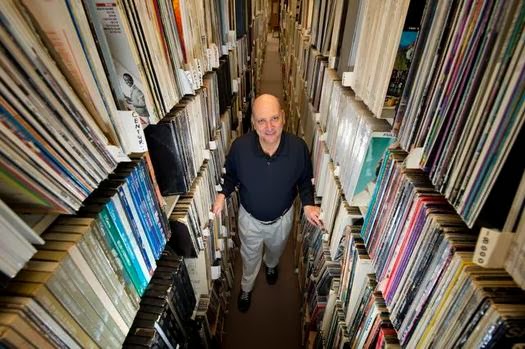
| Chuck Haddix, director of the Marr Sound Archives, which houses the Raymond Scott disc & tape collection. Photo courtesy Kansas City Star. |
As reported in the Kansas City Star:
Chuck Haddix strolled up and down the aisles between the towering stacks of recordings stored at the Marr Sound Archives, in the ground floor of Miller Nichols Library at the University of Missouri-Kansas City. Being surrounded by the treasure-filled shelves — rows and rows of radio broadcasts and music recordings on vinyl, shellac, acetate, metal and glass — seemed to flip a switch in Haddix, and he couldn’t stop talking about the sound locked in the grooves of the preserved discs.
“During World War II when aluminum was scarce, record discs were made of glass,” Haddix, the archives’ director, said. Aluminum, then later glass, formed the interior of records covered with cellulose nitrate, sometimes known as lacquer, which was grooved with the recording.
Because glass discs were easily broken, the ones tucked carefully into acid-free jackets on the Marr archives’ shelves are rare.
But in a few more years, this scene won’t exist. The thousands of discs — one of the largest archived collections of recorded sound in the country — are being relocated to the library’s third floor, where they will be housed in the university’s gargantuan, robotic storage unit.Here's a short (6 minutes) documentary about the Marr Sound Archives, One Room, 317,000 Records, by Jordan Kerfeld.
Subscribe to:
Posts (Atom)