Showing posts with label Marr Sound Archives. Show all posts
Friday, June 16, 2017
Artifacts from the Archives
We are offering a FREE 349-page pdf compendium of Raymond Scott artifacts and ephemera, including previously uncirculated historic material. The contents of Artifacts from the Archives are intended as informational supplements to the Scott albums Three Willow Park, Manhattan Research Inc., and Soothing Sounds for Baby.
The chronological, annotated documents and images spotlight Scott’s career in the field of electronic music, from his 1920s Brooklyn high school days to his 1980s post-Motown years in Los Angeles. Much of the content focuses on Scott’s most productive period, from 1958 (when he began working on electronic music full-time) to 1972 (his first year at Motown). The collection features Scott’s handwritten and typed technical notes, photographs, sketches, correspondence, art, schematics, patents, circuit diagrams, vintage news articles, and family ephemera. The pdf is offered for download in two formats: high resolution (for viewing and printing), and reduced resolution, suitable for paging through on-screen.
Monday, February 17, 2014
"Machines should do the work ..."
"... People should do the thinking."
That proclamation helped make the case for 1967's IBM MT/ST, an early word processing unit heralded in "The Paperwork Explosion," which appears on the Raymond Scott electronica collection, Manhattan Research Inc.
Scott loved technology and embraced most such advances. He might be surprised, yet delighted to know that his collected recorded legacy stored at UMKC's Marr Sound Archive is about to be gobbled up by a giant robot.
As reported in the Kansas City Star:
That proclamation helped make the case for 1967's IBM MT/ST, an early word processing unit heralded in "The Paperwork Explosion," which appears on the Raymond Scott electronica collection, Manhattan Research Inc.
Scott loved technology and embraced most such advances. He might be surprised, yet delighted to know that his collected recorded legacy stored at UMKC's Marr Sound Archive is about to be gobbled up by a giant robot.
![]() |
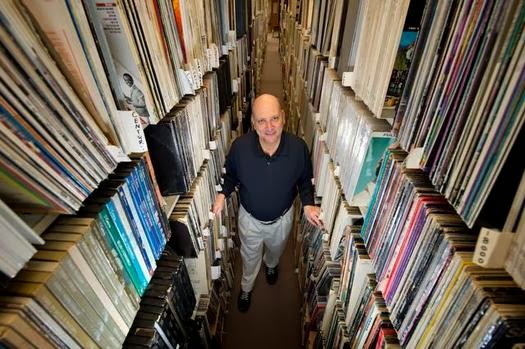
| Chuck Haddix, director of the Marr Sound Archives, which houses the Raymond Scott disc & tape collection. Photo courtesy Kansas City Star. |
As reported in the Kansas City Star:
Chuck Haddix strolled up and down the aisles between the towering stacks of recordings stored at the Marr Sound Archives, in the ground floor of Miller Nichols Library at the University of Missouri-Kansas City. Being surrounded by the treasure-filled shelves — rows and rows of radio broadcasts and music recordings on vinyl, shellac, acetate, metal and glass — seemed to flip a switch in Haddix, and he couldn’t stop talking about the sound locked in the grooves of the preserved discs.
“During World War II when aluminum was scarce, record discs were made of glass,” Haddix, the archives’ director, said. Aluminum, then later glass, formed the interior of records covered with cellulose nitrate, sometimes known as lacquer, which was grooved with the recording.
Because glass discs were easily broken, the ones tucked carefully into acid-free jackets on the Marr archives’ shelves are rare.
But in a few more years, this scene won’t exist. The thousands of discs — one of the largest archived collections of recorded sound in the country — are being relocated to the library’s third floor, where they will be housed in the university’s gargantuan, robotic storage unit.Here's a short (6 minutes) documentary about the Marr Sound Archives, One Room, 317,000 Records, by Jordan Kerfeld.
Tuesday, June 11, 2013
Arnold Eidus (1922-2013)
![]() |
| Raymond Scott and Arnold Eidus, 1950 |
With sadness we note the passing on June 3 of world-renowned violinist Arnold Eidus, at age 90. With pride we note his Raymond Scott connection: in 1950 Eidus performed in a duet setting at Carnegie Hall the only 20th century public recital of Scott's Suite for Violin and Piano. The five-movement Suite was Scott's only known "serious," classical composition, and we've heard anecdotal accounts that it was composed specifically as a showcase for Mr. Eidus. Though he was only 27 at the time, it was not the first time Eidus had appeared at Carnegie Hall—he had performed there as soloist on Lalo's Symphonie Espagnole at age thirteen!
A rehearsal recording of the Suite was discovered in the Scott collection at the Marr Sound Archives, and was released last year on Basta, coupled with a 21st century recording by Davide Rossi and Ramon Dor.
While researching liner notes for the CD, I interviewed Eidus by phone at his Boca Raton home on August 24, 2011. He was a gracious man, and while he could not recall recording or performing the Suite ("I've done thousands of sessions over the years"), he did remember Scott—fondly. "I got along well with him, never had a problem," Mr. Eidus recounted. "I had a pleasant time with him." Unlike a number of musicians who worked in the 1940s and '50s under the demanding bandleader, Eidus said, "I can't say anything bad about him." (Not that we were asking.) The 1950 disc did not indicate the identity of the pianist, but subsequent research revealed it was Carlo Bussotti, who had accompanied Eidus at the 1950 Carnegie concert.
Eidus enjoyed a storied career as a studio accompanist in the jazz, classical, pop, and Latin fields. His session logs include dates for Sinatra, Perez Prado, Wes Montgomery, Lena Horne, Cal Tjader, Doris Day, Freddie Hubbard, and hundreds more. Among his other professional pursuits, Eidus facilitated the hiring of musicians for various projects. When Scott was named conductor on TV's Your Hit Parade in 1950, he needed a string section. Eidus contracted a half-dozen players, and landed a violin chair in the YHP orchestra himself for a year or two. He also recalled touring briefly with Scott, and launched his own classical record label, Stradivari Records, in the 1950s. A busy man, now eternally at rest. Condolences to his family.
Thursday, May 03, 2012
Mitzi Scott (July 18, 1918 - May 3, 2012)
Mitzi Scott passed away in Santa Clarita, CA, on May 3, 2012, at age 93. She was the widow of legendary composer, jazz bandleader and electronic music pioneer Raymond Scott.
Born Mathilde Waldman, on July 18, 1918, in New York City to Muriel and Arthur Waldman, she grew up in the city, where she started dancing at age 10, thus developing a lifelong passion.
From 1937-43 Mitzi was part of the Roxyette troupe at the famed Roxy Theater on West 50th Street. In 1943 she first appeared on Broadway, and eventually performed in the musicals Star and Garter (with Gypsy Rose Lee), Something for the Boys (with Ethel Merman), and the road company of Let's Face It (with Benny Rubin). She performed on three national USO tours, headlined by Bing Crosby, Jackie Cooper, Phil Silvers, Martha Raye, and James Cagney.
In 1946 she married Hewitt Clay Curtis. The marriage dissolved a year and a half later, after which she sold advertising for the Miami Daily News and the Long Island Star-Journal. She became a dance instructor for the world-renowned Arthur Murray Dance Studios, and then served as a District Manager for Avon Cosmetics.
Mitzi was introduced to Raymond Scott in July 1966, and they were married in January 1967. (It was Mitzi's second marriage, Raymond's third.) She lived with Scott in Farmingdale, Long Island, at Willow Park, a sprawling suburban industrial park where Scott rented a large space that he had fashioned into a home and electronics lab. Mitzi undertook the administration of Scott's businesses during a period when he was inventing now-historic electronic instruments and The Electronium, a machine that composed using artificial intelligence. When Scott was hired by Berry Gordy to work for Motown in 1971, the couple relocated to Los Angeles, with Mitzi coordinating most of the cross-country logistics.
In retirement, Scott suffered a major stroke in 1987, which eventually caused severe financial hardship for the couple. Mitzi nursed Raymond almost singlehandedly in their Van Nuys home until his death in February 1994, at age 85. Shortly after her husband's death, Mitzi donated his extensive collection of over 3,000 personally recorded discs and tapes, covering his career from 1932-1987, to the Marr Sound Archives at the University of Missouri, Kansas City. She sold Raymond's no-longer functioning Electronium to Devo's Mark Mothersbaugh in 1996, amid a resurgence of interest in her late husband's music and legacy.
In 1997, Mitzi moved to Santa Clarita and joined a troupe of former professional dancers called the Gingersnaps. She was active in several charitable organizations, including Mes Amis, the North Hollywood Women’s Club, the Women’s Canadian Club and the Hope is Forever Foundation (City of Hope), for which she served as an officer. She was a member of the Sages group at St. Stephen’s Episcopal Church.
She was a passionate animal lover, and regularly took in stray dogs and cats, and adopted rescue animals. In 2007 the National Wildlife Federation designated her back yard as a certified wildlife habitat. She told the Santa Clarita Signal, "Everybody who has a backyard ought to take care of the wildlife. It's very soothing to look out your window and see butterflies and birds."
Mrs. Scott is survived by four stepchildren: Carrie Makover, Stan Warnow, Deborah Scott Studebaker, and Elizabeth Adams, as well as fourteen grandchildren.
A memorial service will be held on Friday, June 22, 11:00 am, at St. Stephen’s Episcopal Church, 24901 Orchard Village Road, Santa Clarita. A reception will follow in the church hall. The service is open to the public.
In lieu of cards and flowers, her family has requested that donations be made in the name of Mitzi Scott to City of Hope (via check payable to "Hope is Forever," mailed to Hope is Forever, c/o Chick Benveniste, 409 Meadows Drive, Glendale CA 91202), or online to the Society for the Prevention of Cruelty to Animals.
Born Mathilde Waldman, on July 18, 1918, in New York City to Muriel and Arthur Waldman, she grew up in the city, where she started dancing at age 10, thus developing a lifelong passion.
From 1937-43 Mitzi was part of the Roxyette troupe at the famed Roxy Theater on West 50th Street. In 1943 she first appeared on Broadway, and eventually performed in the musicals Star and Garter (with Gypsy Rose Lee), Something for the Boys (with Ethel Merman), and the road company of Let's Face It (with Benny Rubin). She performed on three national USO tours, headlined by Bing Crosby, Jackie Cooper, Phil Silvers, Martha Raye, and James Cagney.
In 1946 she married Hewitt Clay Curtis. The marriage dissolved a year and a half later, after which she sold advertising for the Miami Daily News and the Long Island Star-Journal. She became a dance instructor for the world-renowned Arthur Murray Dance Studios, and then served as a District Manager for Avon Cosmetics.
Mitzi was introduced to Raymond Scott in July 1966, and they were married in January 1967. (It was Mitzi's second marriage, Raymond's third.) She lived with Scott in Farmingdale, Long Island, at Willow Park, a sprawling suburban industrial park where Scott rented a large space that he had fashioned into a home and electronics lab. Mitzi undertook the administration of Scott's businesses during a period when he was inventing now-historic electronic instruments and The Electronium, a machine that composed using artificial intelligence. When Scott was hired by Berry Gordy to work for Motown in 1971, the couple relocated to Los Angeles, with Mitzi coordinating most of the cross-country logistics.
In retirement, Scott suffered a major stroke in 1987, which eventually caused severe financial hardship for the couple. Mitzi nursed Raymond almost singlehandedly in their Van Nuys home until his death in February 1994, at age 85. Shortly after her husband's death, Mitzi donated his extensive collection of over 3,000 personally recorded discs and tapes, covering his career from 1932-1987, to the Marr Sound Archives at the University of Missouri, Kansas City. She sold Raymond's no-longer functioning Electronium to Devo's Mark Mothersbaugh in 1996, amid a resurgence of interest in her late husband's music and legacy.
In 1997, Mitzi moved to Santa Clarita and joined a troupe of former professional dancers called the Gingersnaps. She was active in several charitable organizations, including Mes Amis, the North Hollywood Women’s Club, the Women’s Canadian Club and the Hope is Forever Foundation (City of Hope), for which she served as an officer. She was a member of the Sages group at St. Stephen’s Episcopal Church.
She was a passionate animal lover, and regularly took in stray dogs and cats, and adopted rescue animals. In 2007 the National Wildlife Federation designated her back yard as a certified wildlife habitat. She told the Santa Clarita Signal, "Everybody who has a backyard ought to take care of the wildlife. It's very soothing to look out your window and see butterflies and birds."
Mrs. Scott is survived by four stepchildren: Carrie Makover, Stan Warnow, Deborah Scott Studebaker, and Elizabeth Adams, as well as fourteen grandchildren.
A memorial service will be held on Friday, June 22, 11:00 am, at St. Stephen’s Episcopal Church, 24901 Orchard Village Road, Santa Clarita. A reception will follow in the church hall. The service is open to the public.
In lieu of cards and flowers, her family has requested that donations be made in the name of Mitzi Scott to City of Hope (via check payable to "Hope is Forever," mailed to Hope is Forever, c/o Chick Benveniste, 409 Meadows Drive, Glendale CA 91202), or online to the Society for the Prevention of Cruelty to Animals.
Labels:
biography,
family,
Marr Sound Archives,
milestones,
Mitzi Scott,
New York,
obits,
photos,
profiles
Friday, January 15, 2010
record collector's heaven
Jeff Winner of RaymondScott.com on a research expedition at
UMKC's Marr Archives, June 2008, reviewing archival press clippingsIn the mini-doc, Marr director Chuck Haddix explains his mission: "I don't collect records—I collect collectors."
Hat tip to our buddy Mark Greenberg at the Mayfair Workshop blog for noting the video and providing a concise overview of what's in the collection. As a member of Chicago's legendary Coctails, Mark was in the forefront of the Scott revival. The band was performing "Powerhouse" in 1991, when Scott was still a forgotten footnote in music history.
Our Raymond Scott CD releases (on Basta) were compiled from recordings stored at Marr. On a number of occasions, Gert-Jan Blom, Jeff Winner, and I have conducted on-site audio archeology for such projects as Manhattan Research, Inc., Microphone Music, and Ectoplasm. More releases are planned; it's a deep collection of unheard music. Scott was a maniac about recording rehearsals, demos, radio airchecks, mic placement takes, and idea development. An electronica follow-up to Manhattan Research is in the pipeline.
Unfortunately, despite technological progress in field of archiving science, not everything can be restored and preserved:
Tuesday, June 03, 2008
Ray Knew Diddley
![]() |
| Bo Diddley |
Ray met Bo Diddley (a/k/a Ellas McDaniel) when Scott was A&R Director for Everest Records. A surviving tape in the Scott archives from 1958 is a fascinating aural artifact of what may have been an audition; Scott twirls knobs and adjusts levels while Bo runs through several of what were, at the time, new Diddley tunes that have since become classics. Eventually Scott joins him on piano for an impromptu version of "Stormy Weather."
Bo Diddley died yesterday at age 79, during the 100th anniversary of Scott's birth. The world of music will miss them both.
In 2005, Neil Strauss wrote a feature about Diddley for ROLLING STONE, and mentioned the encounter with Raymond Scott:
There is a bootleg tape floating around of Raymond Scott, an inventive musical genius in his own right from the swing era, auditioning Bo Diddley for Everest Records. To hear it is to understand the challenge that Diddley was up against: Scott wanted Diddley to play guitar normally. But that wasn't how Diddley played. His music was all jittery high-end rhythm -- from the tremolo-drenched guitar to the constant hailstorm of maracas. The music Diddley was playing didn't swing or boogie-woogie. It was all about the guitar -- played with fat, clumsy thumbs and tuned to an open E. It wasn't commercial. It was strange.
"I couldn't play like other people wanted me to," Diddley says, with some pride. "I played backwards. You can't change my stuff. I am me."
Labels:
1950s,
artifacts,
biography,
Marr Sound Archives,
profiles
Saturday, January 19, 2008
Poking thru the Scott Archives
Found in the Special Collections division of the Miller-Nichols Library, University of MO @ KC, where sixty years of Scott memorabilia has been preserved since 1995. Downstairs in the library's Marr Sound Archives you can find Scott's recorded legacy (2800 discs and 500 tapes).Written at top: "From the Twentieth Century Fox Picture 'Bread, Butter and Rhythm'"—then crossed out. Ca. 1937. If the film was produced, the web doesn't know about it.
HT: Jeff Winner
Subscribe to:
Posts (Atom)