 Stu Brown's Raymond Scott Project CD draws celebratory ink from the UK's Mojo magazine.
It's also "Disc of the Day" (Nov 2) at The Jazz Breakfast.
Stu Brown's Raymond Scott Project CD draws celebratory ink from the UK's Mojo magazine.
It's also "Disc of the Day" (Nov 2) at The Jazz Breakfast.

Thursday, October 29, 2009
jungle drums, slapped bass & squeaky toys
Stu Brown's Raymond Scott Project CD draws celebratory ink from the UK's Mojo magazine.
It's also "Disc of the Day" (Nov 2) at The Jazz Breakfast.


Wednesday, October 21, 2009
epic bash
"Hitting things with a stick is the cornerstone of civilization," wrote P.J. O'Rourke many years ago. Percussionist-composer Jude Traxler offers a frenetic contribution to civilization with his drum solo on Scott's "Powerhouse," performed as part of the Manhattan School of Music's weekly Power Concerts in December 2008. The camerawork's a bit fuzzy on the YT clip, so we decided to forego a screen grab. Lots of fun to watch, though.
Thanks to MSM trumpeter Andrew Kozar for coordinating the Scott repertoire, which included "Dinner Music for a Pack of Hungry Cannibals," "Tobacco Auctioneer," and "The Penguin."
Sunday, October 18, 2009
Shhh... John Cage & Raymond Scott
More than a dozen Raymond Scott tunes were immortalized in Bugs Bunny classics, but there's one Scott composition that was never heard in cartoons. In fact, it was never heard.
 "The antics of a 13-piece orchestra made audiences fidget and giggle," TIME magazine reported more than a decade before the premiere of John Cage's famous silent composition, 4'33". "The band was going through all the motions: the swart, longish-haired leader led away; the brasses, the saxophones, the clarinets made a great show of fingering and blowing. This, explained leader Raymond Scott, was silent music."
Scott's 1941 audience didn't appreciate the stunt, however. According to Cage, his 1952 presentation also fell on deaf ears: "They missed the point. There’s no such thing as silence. What they thought was silence, because they didn’t know how to listen, was full of accidental sounds."
Raymond conducted other sensory deprivation experiments during this period. The same TIME article claimed he had learned to drive a car with his eyes closed, and that he could "take one look at a parking space, back into it without taking another; memorize a turn the first time, drive it shut-eyed thereafter. Raymond Scott still drives his band open-eyed — with results which, when audible, sound neat and crisp."
Sadly, few recordings of Scott's "Silent Music" survive, and it remains unreleased to this day. However, to any musician brave enough to attempt it we will provide charts.
"The antics of a 13-piece orchestra made audiences fidget and giggle," TIME magazine reported more than a decade before the premiere of John Cage's famous silent composition, 4'33". "The band was going through all the motions: the swart, longish-haired leader led away; the brasses, the saxophones, the clarinets made a great show of fingering and blowing. This, explained leader Raymond Scott, was silent music."Scott's 1941 audience didn't appreciate the stunt, however. According to Cage, his 1952 presentation also fell on deaf ears: "They missed the point. There’s no such thing as silence. What they thought was silence, because they didn’t know how to listen, was full of accidental sounds."
Raymond conducted other sensory deprivation experiments during this period. The same TIME article claimed he had learned to drive a car with his eyes closed, and that he could "take one look at a parking space, back into it without taking another; memorize a turn the first time, drive it shut-eyed thereafter. Raymond Scott still drives his band open-eyed — with results which, when audible, sound neat and crisp."
Sadly, few recordings of Scott's "Silent Music" survive, and it remains unreleased to this day. However, to any musician brave enough to attempt it we will provide charts.
Friday, October 09, 2009
Pasadena Creative Music
The mission of the Pasadena Creative Music series is to showcase many of "the most fun and imaginative performing artists in Los Angeles." And on Monday, October 12th at 6pm, the second half of the program will "explore the music of the legendary composer and inventor Raymond Scott, whose music is widly known through its placement in many Looney Tunes and Merry Melodies favorites, despite the fact that he never actually scored for cartoons. The Los Angeles Raymond Scott Sextet will play a set of these exciting pieces in their original jazz concert context."
Details here: PasadenaCreativeMusic.com
Tuesday, October 06, 2009
The Dought Abides
''I had a big thing for Raymond Scott loops. Hell, I could probably eke out a living producing hiphop records, using nothing but breakbeats and Raymond Scott compositions.''
—MIKE DOUGHTY

"Bus To Beelzebub," from their first album RUBY VROOM, was based on adapted loops from Scott's "Powerhouse," as heard in numerous Bugs Bunny cartoons. "Uh, Zoom Zip," from the same album, uses samples from the RS Quintette's recording of "The Toy Trumpet" that are so distorted they went unidentified for years. By contrast, the loops from the RSQ's "The Penguin" heard throughout SC's "Disseminated," on their 2nd album, IRRESISTIBLE BLISS, are easy to spot. I love the track & think it's one of the coolest uses of Scott samples by any artist, but Doughty is ambivalent. "The lyrics are not my proudest," he explained for SCUG.net. "Don’t get me wrong, I’m pro-nonsense, but at the time we were sequencing the record I dismissed the song as 'harmelodic vaudeville.' Democracy won out, the song made the record, and it ended up being the only damn song on the record that Robert Christgau liked when he reviewed it in Spin."
Doughty is currently working on a new batch of loop-based electronic music, but don't expect more Raymond Scott samples. "After the first record, my bandmates were increasingly unreceptive to loops I brought in from other people's music. Maybe they were right, we woulda been poorer, giving our money away to other composers," he said at MikeDoughty.com. "I could only use the majority of the loops live — gone are the days when Warner Bros. would write a fat check to pay off the Raymond Scott estate and Toots Hibbert for their unsuspecting contributions! Even rappers are too smart to use samples these days."
Monday, October 05, 2009
Raymond Scott Project site updated
 Stu Brown, whose UK Raymond Scott Project we've written about previously, has updated his website, including new press shots and a video clip from the Glasgow Jazz Fest. He intends to add more video over the next few days.
Thursday, October 01, 2009
The thrill of a lifetime ...
 ... a long lifetime (91 years), one of the highlights of which has to be seeing yourself portrayed—however briefly—onstage in a New York theater. That was the honor accorded Mrs. Raymond (Mitzi) Scott on Sunday September 20, after she flew in from the west coast to attend a matinee of Powerhouse, the FringeNYC Festival biographic musical fantasia about her late husband. The cast was told Mitzi would be attending one of the four "Fringe Encore" (extended run) performances, but were not told which—to prevent an added layer of stage jitters (particularly for Clare McNulty, who offered a very sympathetic portrayal of Mitzi). The highly animated performance zoomed along smoothly, and Mitzi adored the show, after which she was introduced to the house and presented by the cast with a bouquet of roses.
The snapshot above was taken outside the Actors' Playhouse on Seventh Avenue after the final curtain. Left to right: Josh Luxenberg (writer); Jon Levin (director and concept); Hanley Smith (Dorothy Collins); Clare McNulty; Eric Wright (Mel, Puppet Designer and Builder); Mitzi Scott; Ben Dziuba (Chuck); Deborah Radloff (Pearl Zimney); Erik Lochtefeld (Raymond Scott); and Jesse Garrison (Carl).
Following the initial August run, the cast was awarded the FringeNYC 2009 Excellence Award for Outstanding Ensemble. The show was one of 20 (out of over 200) that earned a September slot in the Encore series. The next step—if the theatrical gods show favor—is for Powerhouse to open Off-Broadway. Here's hoping. A larger venue and a more accommodating budget would magnify the show's abundant charms.
Wednesday, September 23, 2009
Hell's Half Mile
 Director Stan Warnow, Raymond Scott's son, has an update about his documentary:
"Yes, the film is headed for another festival, the Hell’s Half Mile Film and Music Festival in Bay City, Michigan. If you are in the area I hope you can attend."
There will be two showings: Saturday, October 3rd at Delta College, 11 AM, & Sunday, October 4th at State Theatre, 3 PM. Details here.
Sunday, September 20, 2009
gig alert: Stu Brown's Scott Project
9/24 in Glasgow
 Stu Brown's six-piece Raymond Scott Project has a gig this Thursday in Glasgow, at the Europe Jazz Network Conference. If you're just coming on board, more info about Stu's barnstorming RSP here and here.
Sunday, September 13, 2009
POWERHOUSE (with puppets), Act II
 The New York Fringe Festival production Powerhouse, a freewheeling take on Raymond Scott's life and music, gets an extended life. Four additional performances will be staged Sept 19-21 as part of Fringe Encore, which features the best 19 (out of 200+) shows from the August festival. Ticket and venue details about the show are here. We blogged about the show on August 17, with rave reviews linked at the bottom. Here's another.
 I hadn't seen the show at the time, and later attended one of the final performances of the limited run. The bravos are deserved. Powerhouse the musical, like its novelty namesake, doesn't have a dull moment. It's cleverly constructed and staged at a dizzying pace. For a production featuring real people (and two hand puppets), it might as well be animated. You'll learn a bit about Scott, and be hugely entertained in the process. If you consider yourself even a modest Scott authority, ignore the factual inaccuracies in the chronicle. I told writer Josh Luxenberg and director Jon Levin after the show that it was riddled with historical errors—and that I wouldn't change a word in the script. It's a Raymond Scott fantasia. The cast (six, each playing multiple roles) is charismatic, with physical gestures and facial expressions that match the pacing. At the Festival's closing ceremony, they received an award for "Outstanding Ensemble."
Raymond Scott's widow, Mitzi, is 91 and lives in Southern California. She will be flying to New York next weekend to attend the Sunday matinee, where she will behold herself portrayed onstage by the vivacious Clare McNulty. Twenty years ago, such an event would have seemed unlikely, if not unthinkable.
Thursday, September 10, 2009
Raymond Scott 101:
Happy Birthday
Today is the 101st anniversary of Raymond Scott's birth. But before we eat cake & ice cream, let's review some basics for the kids who were late to class.

Q: When was Raymond Scott born?
A: On September 10, 1908.
Q: Is Raymond Scott still alive?
A: He passed away in 1994 at the age of 85.
Q: Did Raymond Scott write music for cartoons?
A: No, but 20 of his compositions have been immortalized in countless classic animations, from BUGS BUNNY to THE SIMPSONS.
Q: Did BOB MOOG, the inventor of Moog Synthesizers, work for Raymond Scott?
A: Although Bob Moog was more than 25 years younger than Raymond, they were professional colleagues & friends for nearly two decades. Bob acknowledged Ray as an early influence during the 1950s & '60s. Details about Scott-Moog connections here.
Q: Was Johnny Williams, drummer for the 1930s Raymond Scott Quintette, related to JOHN WILLIAMS, the famous film score composer of music for JAWS, STAR WARS, INDIANA JONES, HARRY POTTER, etc.?
A: Yes, they are father & son.
Q: Did Raymond Scott work for MOTOWN?
A: During the 1950s & '60s, Scott perfected his 'Electronium,' an electronic music machine which attracted the attention of Motown owner Berry Gordy, who purchased an Electronium for Motown in September 1970. Scott then became Motown's Director of Electronic Research and Development for several years. Following a serious heart attack in 1977, Scott retired from Motown at age 69.
Q: I've heard that Raymond Scott worked with MUPPETS creator JIM HENSON. Fact or fiction?
A: Henson was more than a quarter-century younger than Scott when they met in the mid-1960s, and they collaborated on experimental art films, industrial reels, and TV projects. Many of the Scott-Henson collaborations are showcased in the 2-CD/144-page book package MANHATTAN RESEARCH INC.
HOMEWORK & FURTHER STUDY:

Wednesday, September 02, 2009
Catch A Brain Wave
On Sunday, August 28th, 1949, newspapers across the globe published this article & cartoon about Raymond Scott's “brain wave” music of the future:

CHICAGO, Aug. 27 - (AP) - Some day composers won't write music, and musicians won't play it — yet fans will enjoy it in never-before-heard perfection. The composer or artist will simply project it by brain waves — "thought transference," says Raymond Scott.
BRAIN WAVES
This man, who thinks in terms of electronics and music, thinks that is all quite possible. Scott said in an interview:
"Brains put out electrical waves. I wouldn't be at all surprised if some day it were possible to do away with lines in music, such as writing it out and playing the notes. You'll just be able to think it.
"Imagine fastening electrodes to your head, inviting some people to your home and then thinking your music. If you wanted 1000 violins you could have them – and if you wanted the bass fiddle to play piccolo parts, you could do that, too."
RECORDINGS, TOO
Scott says even recordings will carry, instead of musical sound, the brain waves of the composer. No arrangers, no rehearsals.
Scott is a New Yorker who has spent most of his adult life working on new developments in his two loves, music and electronics. He maintains a permanent electronics research laboratory in New York, while he composes music and directs his bands for radio shows and night club appearances. His musical theories have always been off-beat.
Friday, August 28, 2009
BBC Radio Interview
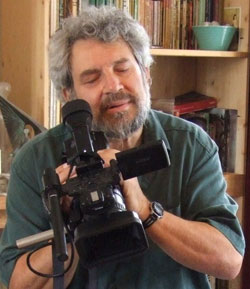
The BBC World Service radio arts program, The Strand, recently aired an interview with Raymond Scott's son, Stan Warnow, about his forthcoming documentary film, DECONSTRUCTING DAD. Listen to the feature, which also utilizes generous portions of Stu Brown's new CD: here<<
photo of Stan Warnow
by: Gert-Jan Blom
Monday, August 17, 2009
POWERHOUSE — with puppets
 We'll just quote part of the press release for this intriguing production currently running at the New York Fringe Festival (ecstatic reviews posted at bottom):
With puppetry and live action, swing dancing and physical comedy, POWERHOUSE tells the story of a brilliant man who wrote music that nearly every American has heard and yet almost no one can identify. It’s 1936 and 27 year-old Harry Warnow has it all — a beautiful wife, a hit record, a recording company, a publishing company, his very own swing orchestra and a new name: Raymond Scott. But in 30 years he would be virtually unknown. Secluded in his home studio, he would spend his time writing commercials and inventing futuristic music machines. Unbeknownst to Scott, however, his music had become imprinted on the minds of millions. For years, the animators at Warner Bros. had been scoring their Looney Tunes cartoons with Scott’s life’s work. This would be his legacy — and he never knew. Featuring puppets playing cartoons, people playing machines, and machines playing music, the acclaimed Sinking Ship Productions presents the world premiere of POWERHOUSE at the 2009 New York International Fringe Festival.You can download a pdf of the show's press release here. The production opened Saturday. Scott's son Stan Warnow was impressed, emailing: "It was well done and inventive. Staging and directing were very good. It was fluid and moved right along, lots happening on stage." Although we haven't yet seen the production, we met with Jon Levin and Josh Luxenberg a few months ago while they were researching the project. Their absorption with the details of Scott's legacy conveyed impressive intentions to tell the story respectfully, if idiosyncratically. And they were nice guys, so we're cheering them on.
Update 1: reviewed by The New York Times Arts Beat:
Powerhouse, which somehow manages to pack very funny puppetry, exuberant dance numbers, fascinating historical tangents, a mountain of narrative and a vivid sense of period mood into one steam train of a drama, is the rare Fringe show that lives up to its title.
Finally, after all these years, I met Raymond Scott! I had read he was only about 5'9", but apparently that was just part of the Scott mythology. He's actually 6'5". Photographic evidence:
 Photo: Das Überbabe
Subscribe to:
Posts (Atom)